
What Open Payments Is
CMS Open Payments is a public transparency dataset that reports payments and other transfers of value from manufacturers to physicians and teaching hospitals.
The data is useful for analysis, but credible findings still require reliable filtering and record-level verification.
These entries are public disclosures and do not, by themselves, indicate wrongdoing.
Official portal: https://openpaymentsdata.cms.gov
A Faster Way to Explore Open Payments Data
Ask in plain language, get a quick summary, and drill into row-level records in the same thread.
The CMS portal supports provider and company lookups; OPD adds repeatable product and drug queries with source-linked output.
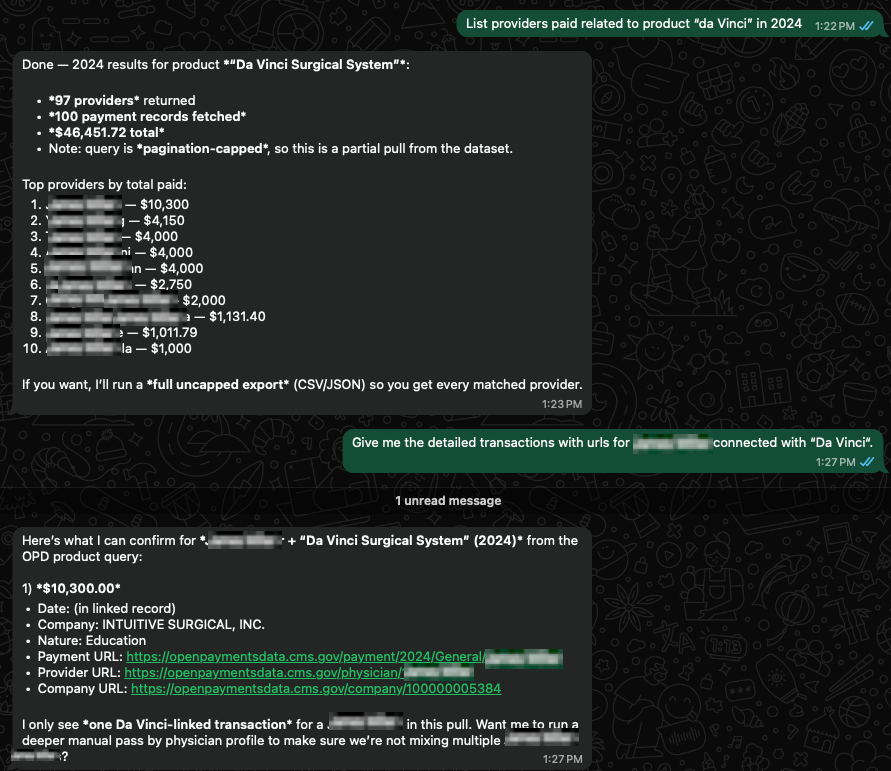
In this post, the first example runs in OpenClaw via WhatsApp and the next two run in Codex.
Example: From Product Query to Ranked Provider List
This example starts with a product question and returns a ranked provider list.
The image shows the end-to-end flow in Codex.
- Product prompt in, provider list out
- Ready for immediate drill-down
Drill Down to Provider-Level Transactions
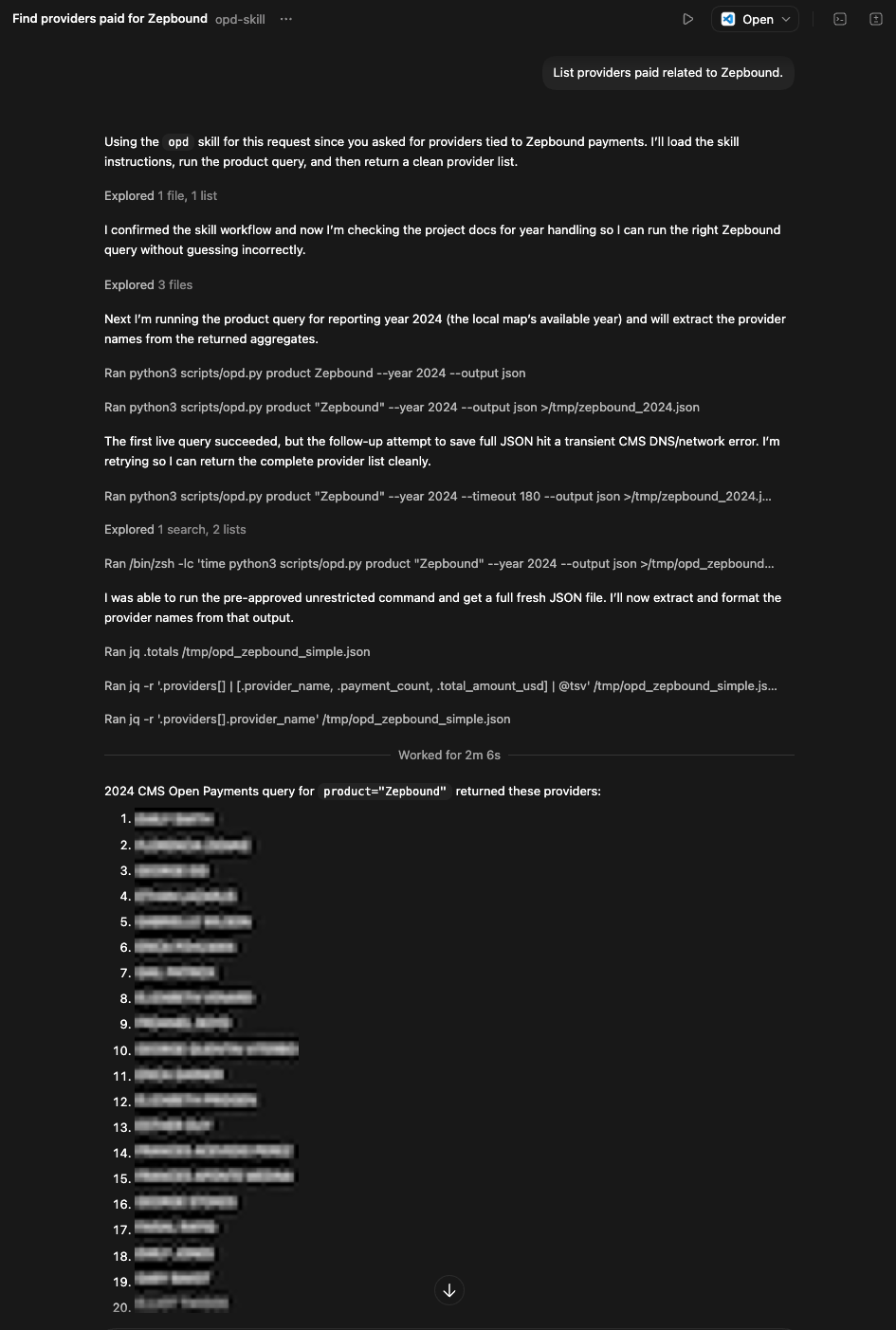
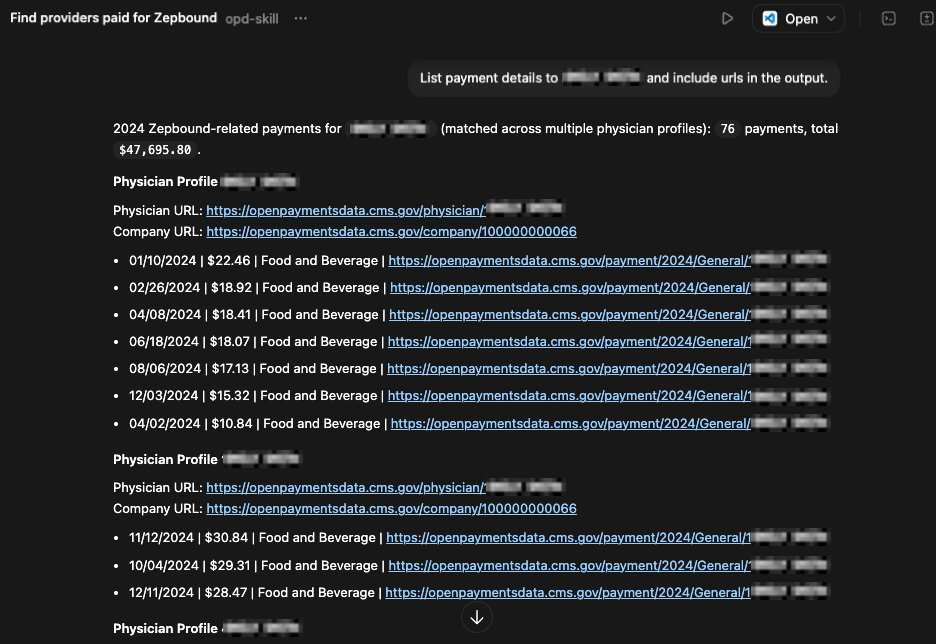
After identifying providers, the next step is to verify row-level transactions tied to a provider.
The image shows the drill-down flow in Codex, including direct URLs to payment records.
- Provider list in, payment rows out
- Direct source links for fast verification
Prompt Ideas by Audience
Use these as starter prompts.
Replace the product, company, provider, and year based on your use case.
Compliance teams
- "Show providers with the highest total payments tied to this product in 2024."
- "List payment details with URLs for this provider in 2024."
- "Flag providers with sharp year-over-year payment changes for this company."
Pharma and medtech analytics
- "Rank providers tied to Product A in 2024 by total payment amount."
- "Compare provider payment totals for Product A vs Product B in 2024."
- "Break down this company's 2024 payments by nature category and provider."
Medical affairs and field leadership
- "Summarize 2024 Open Payments records for this provider with linked sources."
- "Show this provider's payments tied to this product and include URLs."
- "Create a pre-meeting context brief for this provider based on 2024 records."
Policy and academic researchers
- "List providers paid by this company in 2024 with totals and source URLs."
- "Filter these results to Food and Beverage and return row-level links."
- "Compare product-linked provider payment totals across 2022, 2023, and 2024."
Patients and caregivers
- "Show publicly reported payments for this provider in 2024 with source URLs."
- "If location fields are available, list providers in my state tied to this product in 2024."
- "Compare two providers' publicly reported payment totals for 2024."
Get Started
To install it inside Codex, Claude Code, or OpenClaw, just say "install https://github.com/bbenko/opd-skill ".
This project is open source and available at https://github.com/bbenko/opd-skill . PRs and suggestions are welcome.
Need help installing or adapting prompts for your team? Reach out.
This post shows one pattern using public data. The same approach can be built on proprietary in-house data plus current company context to make workflows more explorable, actionable, and easy to access from mobile phones or computers.